

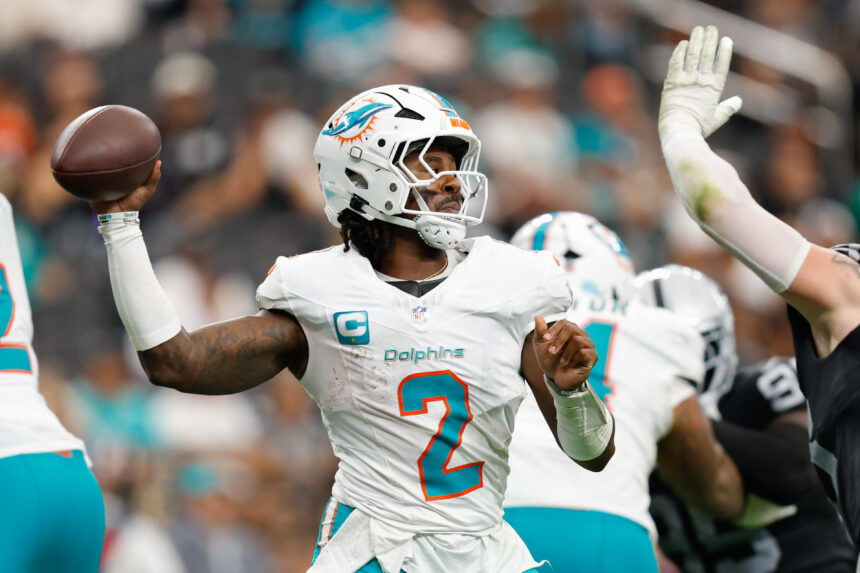
Chris Perkins has seen enough from Malik Willis to entertain a different path for the Miami Dolphins in the next NFL draft, even as the quarterback’s evaluation remains in its earliest stages.
In a Tuesday post promoting “Dolphins Deep Dive,” the Sun Sentinel columnist offered an initial assessment that Miami might not need to spend a first-round selection on another quarterback. He also cautioned that two games were far too little evidence for certainty.
“Right now I’d say the Fins don’t need to draft a QB in the 1st rd,” Perkins wrote on X.
That possibility would carry consequences beyond the quarterback room. If Willis establishes himself as a dependable starter, Miami could use a premium selection to improve the players around him.
If his early flashes fail to become consistent production, the Dolphins would still have reason to consider adding a quarterback.
Perkins’ assessment is an opinion about that choice, not a report that Miami has settled its draft plans. The distinction matters with the Dolphins 0-2 and Willis still trying to put together a complete performance.
What Malik Willis has shown through two starts
The first two games offer evidence for both patience and caution. Willis has generated passing yardage without a large number of attempts, but Miami has yet to translate that production into enough points.
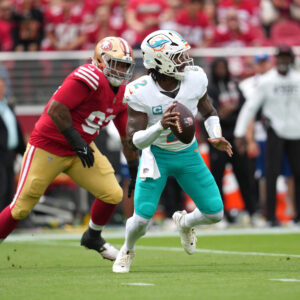
He completed 15 of 27 passes for 220 yards in the season-opening loss to Las Vegas. Against San Francisco, the official box score credited him with 14 completions on 23 attempts for 197 yards.
| 2026 game | Completions/attempts | Passing yards | Completion rate | Yards per attempt |
|---|---|---|---|---|
| Week 1 at Raiders | 15/27 | 220 | 55.6% | 8.1 |
| Week 2 at 49ers | 14/23 | 197 | 60.9% | 8.6 |
| Combined | 29/50 | 417 | 58.0% | 8.3 |
Those totals produce an interesting split: Miami has gained 8.3 yards per passing attempt, yet Willis has completed only 58.0 percent of his throws.
The yardage suggests there is value in the completions he is producing, while the completion rate leaves room for a more reliable passing game.
Neither figure establishes how often Willis made the correct read or whether a missed connection resulted from an inaccurate throw, a receiver’s mistake or another factor. With only 50 attempts, individual plays also have considerable influence on the averages.
His late touchdown and postgame response against San Francisco already illustrated why the circumstances around the production matter. The next stage of his evaluation is whether Miami can get useful passing results repeatedly, while the outcome remains in reach.
Jeff Hafley identifies the next step for Willis
Hafley’s assessment provides a more specific framework for that evaluation. Asked Monday about Willis’ first two games, the coach praised the quarterback’s accuracy, downfield opportunities and ability to extend possessions with his movement.
“I just think it’s the consistency right now,” Hafley said in the team’s transcript of his Sept. 21 news conference.
He identified a particular challenge when Miami falls behind and opponents can anticipate a pass: Willis must work through his reads with the right timing, and the receivers must arrive where the play requires them to be.
Hafley also described the quarterback as still developing familiarity with his teammates.
That gives the Dolphins something more concrete to evaluate than whether Willis produces a memorable escape or a long completion. A quarterback who can consistently execute those expected passing situations gives his offense a better chance to function when the defense knows what is coming.
The value of his mobility remains part of the assessment. In the opener, Willis added 39 rushing yards and a touchdown on five carries.
But extending the season’s promising moments into a case for keeping the starting job will require progress in the ordinary passing situations as well.
What would change Miami’s quarterback calculation?
For Perkins’ early assessment to hold up, Willis needs to make the decision to retain him easier over a much larger sample.
Improving the routine completions, sustaining possessions and responding when defenses adjust would provide stronger evidence than either a single highlight or the team’s record alone.
The roster-building benefit would be flexibility. A first-round pick spent on another position could help Willis directly or strengthen a different part of the team, although Miami would still need to weigh the quarterbacks available against its other options.
There is no need to settle that choice after two games. Perkins has raised a credible question for the season ahead, and Hafley has identified the consistency Miami needs to see before an encouraging possibility can become a convincing answer.