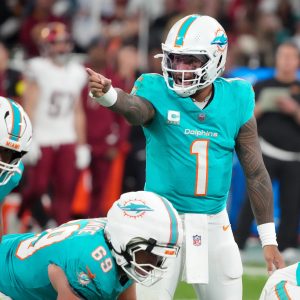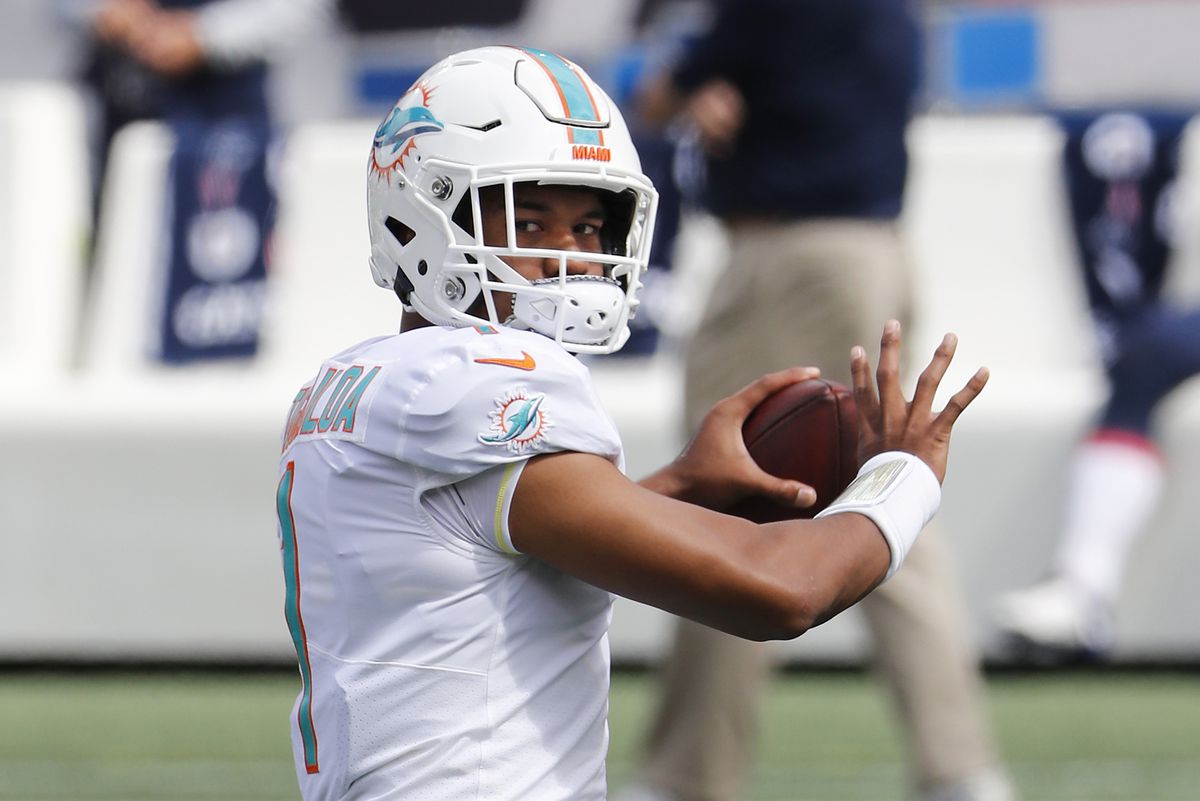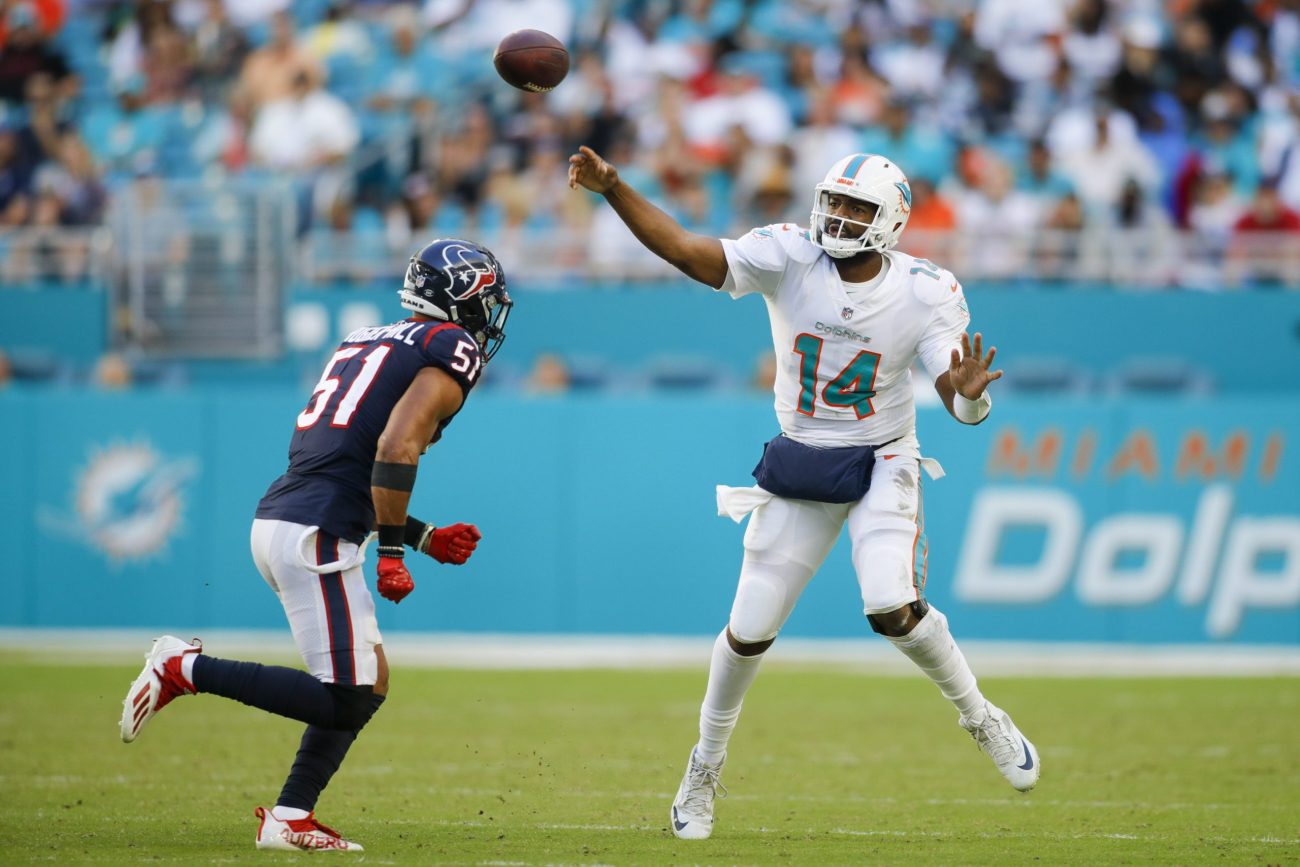



Barry Jackson sees a potential path for the Miami Dolphins to land Ohio State receiver Jeremiah Smith, but his proposed scenario begins with Malik Willis making Miami comfortable at quarterback.
The Miami Herald reporter raised the possibility Saturday as Smith delivered a four-touchdown performance against Illinois. Jackson suggested that a successful season from Willis could give the Dolphins room to consider a trade down with a team seeking a quarterback, collect additional selections and still draft Smith.
Every Dolphins fan should be hoping that Malik Willis becomes a clear cut franchise QB so that Miami can seize on the desperation of a QB needy team, trade down a couple spots for more picks and take Jeremiah Smith.
— Barry Jackson (@flasportsbuzz) September 26, 2026
“Every Dolphins fan should be hoping that Malik Willis becomes a clear cut franchise QB,” Jackson wrote.
That is a proposed strategy, not a report that the Dolphins have chosen their next quarterback or identified Smith as their draft target. It also depends on more than Willis playing well: Miami would need the right draft position, a willing trade partner and a reasonable expectation that Smith would remain available.
Saturday supplied another reason to consider the possibility.
Jeremiah Smith gives Miami’s draft discussion a concrete target
Smith finished with 12 catches for 217 yards and four touchdowns in Ohio State’s 42-19 victory over Illinois. The Buckeyes’ official game recap confirmed that his four touchdown receptions matched the school’s single-game record.
The distribution of that production helps explain the interest. Ohio State finished with 367 passing yards, meaning Smith accounted for 59.1 percent of the total.
He also caught all four of Julian Sayin’s touchdown passes, making him responsible for the entirety of the Buckeyes’ scoring through the air.
His contribution included a 72-yard touchdown and a nine-yard score. That combination gave Ohio State both a quick scoring play and a finish to a longer possession, rather than a receiving total built entirely around one explosive catch.
Jeremiah Smith with his FOURTH ‼️
He ties @OhioStateFB's all-time receiving TD record in a game pic.twitter.com/XjLXjRfXDb
— FOX College Football (@CFBONFOX) September 26, 2026
The Dolphins connection is the chance to add that kind of receiving production while keeping their quarterback in place. Under Jackson’s scenario, Miami would be using a valuable pick to support Willis and acquiring additional selections to address other needs.
Miami’s immediate receiving situation is separate from that longer-term discussion. The Dolphins are preparing to play without Caleb Douglas against Kansas City, and the team’s injury report lists his ankle injury with an out designation.
An injury in September does not determine what a team should do in the next draft. The relevant question would be whether Smith represents a sufficiently valuable addition to justify the selection after Miami evaluates its existing receivers over the rest of the season.
A trade down would carry its own risk
Jackson’s proposal offers an attractive combination: adding a receiver while receiving compensation for letting another team move up. Those two benefits, however, cannot be assumed to arrive together.
If Miami were in position to select Smith, moving back would give another team a chance to take him first. Even a short move could matter if the teams between the original pick and the new one valued Smith more highly than the other available players.
Jackson recognized that uncertainty in a follow-up post Saturday. He acknowledged the alternative of selecting the prospect a team trusts most, regardless of position, when it cannot be confident that a trade partner intends to choose a quarterback.
This also an option obviously, if you can't be sure that team trading up takes a QB. You take the most can't miss prospect regardless of position! https://t.co/rvbuhK12Vg
— Barry Jackson (@flasportsbuzz) September 26, 2026
That qualification matters because it separates two decisions that are easy to combine in a hypothetical. Miami could decide it wants Smith without deciding that a trade down is the best way to acquire him.
Conversely, it could receive a compelling trade offer without being able to preserve its preferred receiving option.
The value of any offer would have to be weighed against the players the Dolphins might lose access to by accepting it. Additional selections could help elsewhere on the roster, but they would not make Smith available again if another team picked him.
There is also no basis in Jackson’s posts for assigning a particular return. He did not identify a trade partner or specify the selections Miami would receive.
Until draft order, prospect evaluations and another team’s interest are clearer, attaching an exact package would turn a general proposal into an invented negotiation.
Miami still has to decide what it has at quarterback
The first condition in Jackson’s proposal remains the most consequential. Willis would need to give Miami enough confidence that it could prioritize another position rather than view the draft as an opportunity to upgrade at quarterback.
That broader question already surfaced in Chris Perkins’ early assessment of Willis. Jackson’s Saturday post adds a specific receiver and a possible transaction to the discussion, giving the idea a more defined destination.
There is a competing approach. Miami Herald reporter Omar Kelly argued Saturday that the Dolphins should remain willing to add a quarterback.
Take the QB. Stop running from competition.
Green Bay never ran and had elite QBs https://t.co/sMr673GI5s
— Omar Kelly (@OmarKelly) September 26, 2026
“Take the QB. Stop running from competition,” Kelly wrote.
His post pointed to Green Bay’s willingness to invest in the position despite already having accomplished quarterbacks. The underlying question for Miami is how much confidence in Willis would be enough to pass on a quarterback it otherwise liked.
A receiver and a quarterback would serve different purposes in that decision. Selecting Smith could improve the supporting cast for the incumbent.
Selecting a quarterback could create competition or offer an alternative if the Dolphins were unconvinced about their current answer.
That choice should also depend on the specific prospects available. It would be difficult to justify passing on a quarterback Miami considered a major upgrade simply because a receiver was appealing.
It would be equally difficult to justify forcing a quarterback selection if the team regarded another player as substantially better.
Smith’s performance strengthens the appeal of Jackson’s idea, but it does not resolve those evaluations. The Dolphins would first need a clear view of Willis, then an opportunity to select Smith and finally a trade offer that made moving down worth the risk.
For now, Jackson has offered a concrete reason for Dolphins fans to want Willis to succeed: it could expand Miami’s options when a receiver such as Smith is available.