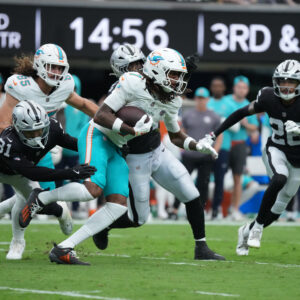

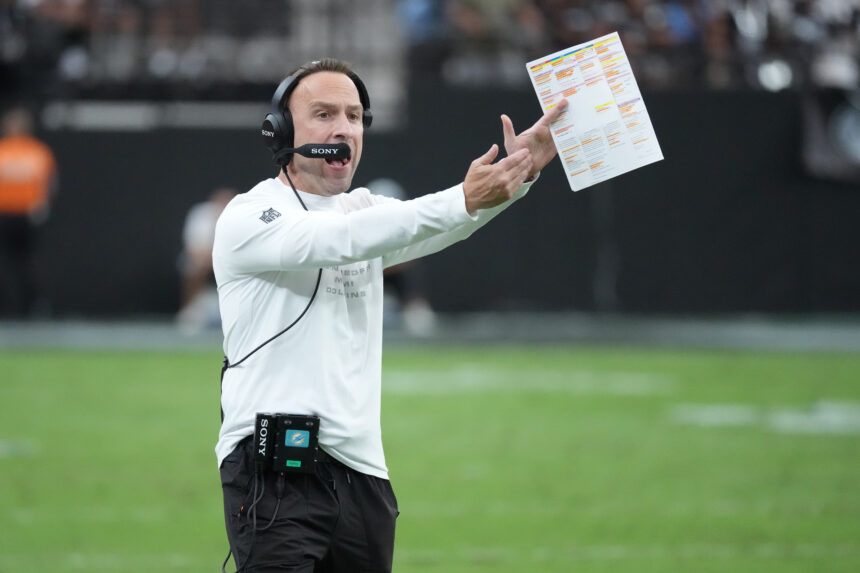
Jeff Hafley coached his first game as an NFL head coach on Sunday, lost it 27-13 to the Las Vegas Raiders, and walked into his postgame press conference ready to fine one of his own cornerbacks over a penalty his beat writers thought should never have been thrown.
The player is JuJu Brents, flagged for taunting in the second quarter on a third-down incompletion that should have sent the Raiders’ punt team onto the field. Hafley told reporters he was informed the call was taunting and had no clarity beyond that, but said Brents will be fined if the review determines it was in fact taunting.
Hafley said he was told Juju Brents was called for taunting, but didn’t have any clarity beyond that
Called it one of the biggest moments of the game and said if they determine it was indeed taunting, Brents will be fined
“Can’t do it — that’s 7 points right there”
— Marcel Louis-Jacques (@Marcel_LJ) September 13, 2026
“Can’t do it — that’s 7 points right there,” Hafley said.
That is a strong position to take after one game, on a play the coach admitted he had not yet seen on film, and it tells you something about how the new regime intends to handle the margins on a roster that cannot afford to give any away.
What Brents did, and what it cost
The sequence started well for him. Two plays before the flag, Brents fought off a block on a double reverse and dropped Malik Benson for an 8-yard loss, which put the Raiders behind the chains at their own 30.
On third-and-13, Kirk Cousins went deep to Tre Tucker, and safety Zayne Anderson arrived with a hit that separated Tucker from the ball.
What happened next is Brents was seen giving the incomplete signal and moving toward Anderson, drifting partly over the receiver as he celebrated. The flag came out, the Raiders got 15 yards and an automatic first down, and the possession that should have ended in a punt instead ended with Las Vegas up 10-0.
Extremely questionable “taunting” penalty against #Dolphins CB JuJu Brents. I mean, there’s absolutely nothing there, as both commentators also said.
Just a young player celebrating a great play his teammate just made. 🤷🏻♂️ pic.twitter.com/2y5MA65eCf
— Jordan Schultz (@Schultz_Report) September 13, 2026
Hafley’s arithmetic is worth a note. The extended drive produced a field goal, not a touchdown, but the coach’s point survives the math: On a day when Miami did not force a Raiders punt until the fourth quarter, handing Cousins a free set of downs was the difference between the one stop his defense had earned and none at all.
Two beat writers, same verdict
Neither of the reporters who have covered this team longest thought the flag belonged. Alain Poupart, writing at halftime, said the television replay showed nothing especially bad from Brents and that the call may have been more about an “overzealous official” than the player.
Joe Schad went further on the call and then turned it back on the player. He called the penalty “debatable but significant,” wrote that it looked like a weak call unless something was said that the broadcast did not catch and then added the line Hafley would probably endorse: Those are the flags Miami cannot afford to even risk.
That is the crux. Whether the officials got it right is a question for the league’s Tuesday grading. Whether a Dolphins defender should be anywhere near a receiver he just watched get hit, with the game 7-0 and the Raiders about to punt, is a question Hafley has already answered.
Why Hafley is fining him anyway
The coach did not pretend to know more than he did about the call itself.
“They called him for taunting,” Hafley said. “I’ll watch the film. They just said they called him for taunting. It obviously was one of the biggest plays in the game.”
The fine is not really about Brents alone. Miami was flagged up and down its offensive line, with holding calls on Patrick Paul and Aaron Brewer, a hands-to-the-face on Austin Jackson and a false start on Kadyn Proctor.
There were two penalties on Brewer in the first half alone, and Paul, who had already made the Maxx Crosby matchup personal, drew a hands-to-the-face of his own against Crosby late.
Hafley’s read on the offense was the same one he applied to Brents.
“The penalties killed us. We didn’t stay on track,” he said.
Malik Willis said much the same thing from the other side of the ball, taking the sacks and the operation on himself, but the coach chose one play and one player to attach a consequence to, and it was the one that turned a punt into points.
There is a logic to it. A team that started six rookies is going to lose games on talent this year.
Losing them on a celebration is the one category a coach can actually legislate, and Hafley chose Week 1 to say so out loud.
What comes next
Whether the money comes from the league office, which reviews every flagged play during the week and issues fines for taunting under its standard schedule, or from the team, Hafley did not specify.
What he did specify is that the film decides it, which means Brents’ Monday is going to involve a meeting he would rather skip.
Miami needs him on the field regardless. The secondary got thinner during the game, with Hafley saying he does not yet know the extent of Kyle Louis’ knee injury and Ronnie Harrison Jr. being questionable to return with a hamstring.
Louis was only moved to safety two weeks ago, and the three-man rotation there is now a question mark heading into a trip to Levi’s Stadium next Sunday.
The loss itself was the one Ryan Fitzpatrick warned about last week, and the 49ers will not be a softer draw. But the Brents fine is the first real window into how Hafley plans to run the building when things go wrong, and the answer is that he will name the play, name the cost and make the player pay it — even on a flag he might have argued himself.