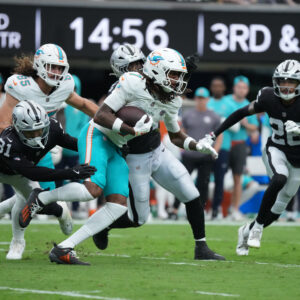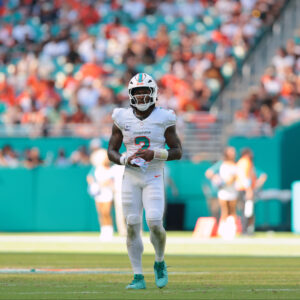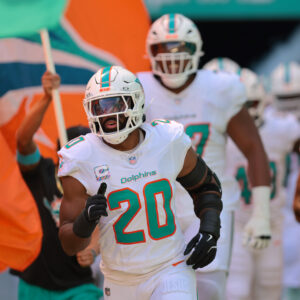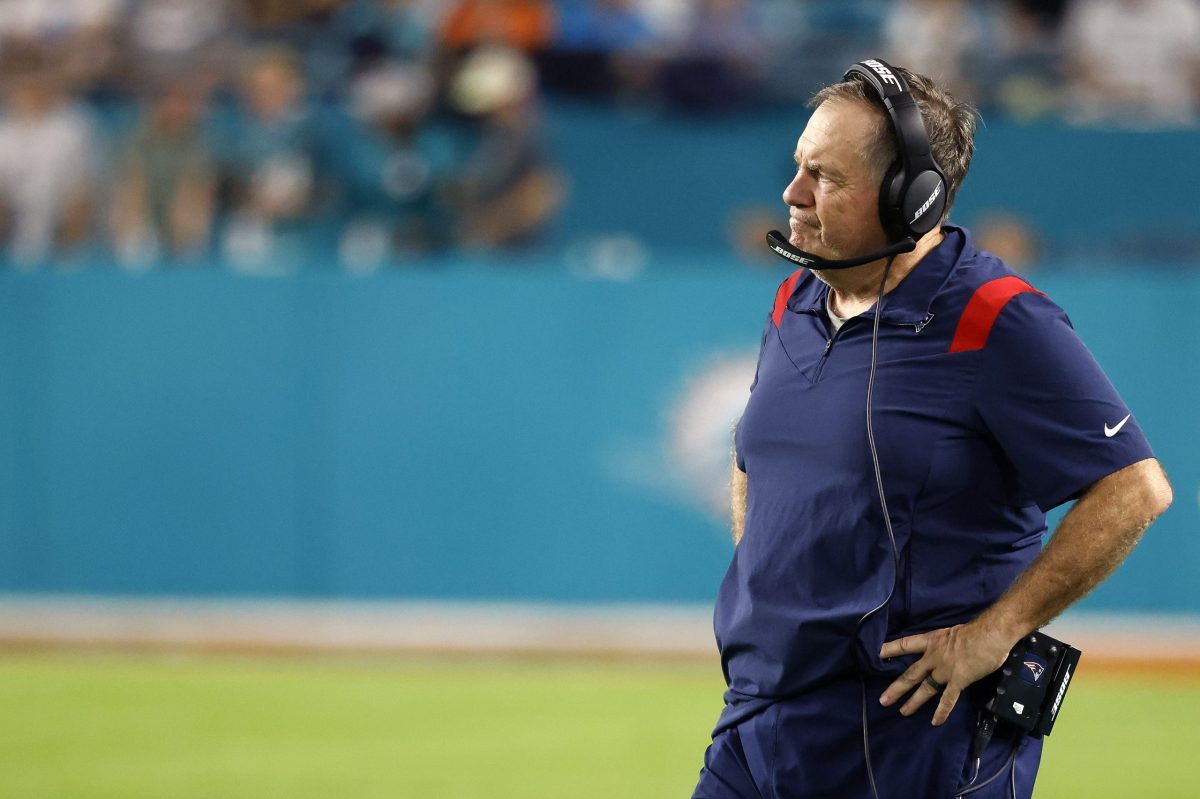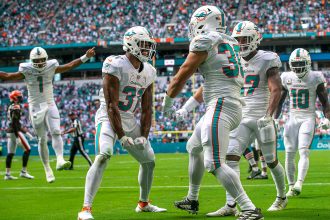



Three practices into Jeff Hafley’s first Miami Dolphins training camp, the play style the franchise bet its quarterback reset on finally showed up in full.
Friday’s session was Malik Willis’s best of the summer by the consensus of everyone watching, and the reason had as much to do with his legs as his arm.
Through the first two days, Willis had operated almost entirely within the structure of the passing game, and the results were rocky. Friday was different.
The significant development was that Miami finally got to see Willis “unleash his running ability” after everything to that point had stayed inside the framework of the passing offense.
One thing that was significant about Friday’s Miami Dolphins practice is that we finally got to see Malik Willis unleash his running ability.
It had all been within the framework of the passing offense to that point. pic.twitter.com/uu42y6ijTM
— David Furones (@DavidFurones_) July 31, 2026
A Red-Zone Day Built for What Willis Does
Friday’s practice leaned heavily on situational work, with the offense spending much of the session in the red zone — exactly the compressed space where a quarterback who can escape changes the math.
Willis took advantage, scrambling for a touchdown and adding a scoring throw to tight end Ben Sims. The quarterback showed off his speed, and the day was his best training camp performance to date.
The Malik Willis touchdown pass to TE Ben Sims at Dolphins’ third training camp practice. pic.twitter.com/yszbiK1eWR
— David Furones (@DavidFurones_) July 31, 2026
Omar Kelly gave the performance its honest framing in his observations from the session. He noted the offense redeemed itself somewhat on the red-zone day and called it Willis’s best showing, before adding the caveat that keeps this from becoming a coronation.
So today was a red zone day for the Dolphins and the offense redeemed themselves a little. This was Malik Willis’ best showing. He scrambled for a TD and threw a couple. Was he GOOD? Not really.
Final play ended with Willis getting sacked by Zach Sieler on a third and goal with…
— Omar Kelly (@OmarKelly) July 31, 2026
“Was he GOOD? Not really,” Kelly wrote.
That tension is the honest state of the quarterback three days in. The flashes are real, the athletic advantage is obvious, and the polished passing performance the Dolphins ultimately need has not arrived yet.
What Friday established is which direction the arrow is pointing.
Why the Legs Change Everything
The most interesting evaluation of Willis on Friday came from the other side of the ball. Rookie safety Dante Trader Jr. described the problem a scrambling quarterback creates for a defense that is built to win within a normal play clock, telling reporters that defenders accustomed to holding coverage for a standard dropback suddenly face a different job entirely.
“Covering for 3 second is hard already. Imagine having to cover for 6 seconds,” Dante Trader Jr. on Malik Willis’ mobility. “you got to know where he is, and you have to know the scheme of the call.”
— Omar Kelly (@OmarKelly) July 31, 2026
“Imagine having to cover for 6 seconds,” Trader said. “You got to know where he is, and you have to know the scheme of the call.”
His teammates in the backfield see the same thing from the other angle. Running back De’Von Achane said earlier in the week that opposing defenses will have to devote real attention to Willis’s ability to make plays with his feet, a stress Miami’s offense simply did not place on anyone a year ago.
Between Achane’s speed, a receiver group learning to extend routes when the play breaks down and a quarterback who turns broken plays into first downs, the identity Hafley’s staff is building looked coherent on Friday for the first time.
That is also precisely why the coaching staff’s early restraint was notable. Keeping Willis inside the passing structure for two days was a deliberate teaching choice, not an accident — the Dolphins need him to prove he can operate on schedule before the escape hatch becomes the plan.
Friday suggested the staff is ready to start blending the two.
The 3-Day Arc: Rust, Turnovers, Bounce-Back
The arc matters because the first two days were genuinely rough. Willis opened camp Wednesday with an uneven performance that Hafley waved off, telling reporters he refused to grade anyone on one practice.
“Is Malik (Willis) going to be where he is in five weeks? No,” Jeff Hafley says, adding everyone had some rust, including Hafley. pic.twitter.com/h7hNrl6yQ5
— Joe Schad (@schadjoe) July 30, 2026
“Is Malik going to be where he is in five weeks? No,” Hafley said, adding that everyone had rust to shake off, himself included.
Thursday was worse. The defense spent Day 2 taking the ball away, with Zayne Anderson intercepting a Willis pass that deflected off Tutu Atwell and Ronnie Harrison adding another pick later in the session.
The biggest offensive play of that practice — a deep Willis connection to Malik Washington over the middle — hinted at what was coming, but the day belonged to the defense.
Which is what made Friday a legitimate data point rather than noise. Willis bounced back on a heavy situational day, and doing it in red-zone work — where every mistake is amplified and every escape is a touchdown — is the most encouraging version of a bounce-back available in July.
Rookie receiver Caleb Douglas turning in an active practice on the same day only sweetened the file for an offense searching for young pass catchers to emerge.
Zach Sieler’s Reminder
The defense still got the last word, literally. Practice ended with Zach Sieler beating rookie guard Kadyn Proctor off the snap and sacking Willis on a third and goal, closing the session the way Miami’s veteran interior force has closed a lot of them.
Proctor, learning guard after playing tackle in college, owned the rep afterward and pointed to getting off the ball faster as the correction.
That closing snapshot is a useful check on the whole day. Willis’s legs bailed the offense out of several downs Friday, and the play that ended practice was one his legs could not fix.
The line in front of him is breaking in a rookie at guard, the interior of Miami’s defense remains the best unit on the field and the passing operation is still catching up to the athleticism. All of that is normal for practice No. 3. None of it is settled.
What It Means for the Willis Bet
Miami’s offseason gamble was never that Willis would arrive as a finished pocket passer. The bet was that his dual-threat skill set, paired with Achane and a rebuilt offensive line, gives Hafley’s offense a stress point defenses cannot ignore — and that the passing polish comes with reps.
Friday was the first practice where that theory looked like a plan instead of a hope. Hafley’s own five-week framing is the right lens. The measurement is not whether Willis wins a July practice; it is whether the version of him running Miami’s offense in September looks meaningfully different from the one who opened camp rusty on Wednesday.
Day 3 was the first practice that suggested the arrow is moving, and the next test is straightforward — do it again when the defense knows the legs are coming.