

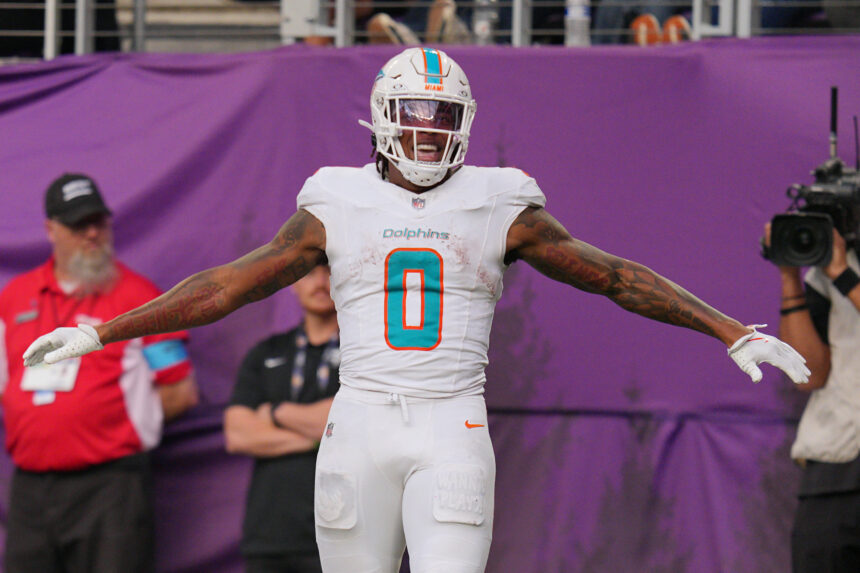
Ollie Gordon II gave the Miami Dolphins more than a 100-yard rushing performance Sunday. He gave them a stronger case for making him the busiest runner in their backfield.
Gordon finished with nine carries for 100 yards and a touchdown in Miami’s 15-10 loss to the Minnesota Vikings. The more revealing development came in the division of work: Jaylen Wright started, but Gordon finished with 22 offensive snaps to Wright’s 12.
That combination of opportunity and production matters as Miami builds an offense without De’Von Achane. Gordon delivered the larger workload and the bigger plays with Wright available, giving the coaching staff a different evaluation from the injury-depleted backfield it had the previous week.
It does not establish that Jeff Hafley has named a new starter. It does establish that Gordon made the most of his chance to lead the rotation.
Gordon’s workload tells a different story from the depth chart
Dolphin Nation previously reported that Wright was listed first on Miami’s depth chart as he returned to full practice. Sunday’s result supplies the next piece of that story: The player who opened the game did not end up handling the most work.
Gordon played 10 more offensive snaps than Wright. That is a meaningful difference in a limited set of opportunities, although it should not be treated as a promise about next week’s rotation.
Wright’s official game log lists five carries for seven yards against Minnesota. His longest run gained seven yards, meaning his other four attempts produced a combined net of zero.
Those numbers describe the outcome, rather than assigning responsibility for every unsuccessful play. Blocking, defensive positioning and the situation surrounding a handoff all affect what a runner can do.
Still, Gordon supplied the production Miami needed while Wright struggled to create a comparable return on his opportunities.
For the coaches, that creates a practical question: how much of Sunday’s division should carry into the next game? Gordon has supplied evidence in his favor, even if one afternoon cannot settle every assignment.
A 53-yard burst and a touchdown strengthen Gordon’s case
The Dolphins’ official statistics for Gordon show just how different Sunday was from his previous outing. He gained 41 yards on 17 attempts against Kansas City, then reached 100 on nine carries in Minnesota.
His longest gain was a 53-yard run shared by Dolphin Nation. Gordon also scored on a 12-yard touchdown run, giving Miami a rushing threat that extended beyond simply picking up short gains.
OLLIE GORDON RIPS OFF 53 YARDS pic.twitter.com/moGplcr6zC
— Dolphin Nation (@Dolphin_Nation) October 4, 2026
The long run accounted for more than half his rushing total, but the rest of his afternoon also deserves attention. Subtracting those 53 yards leaves 47 yards on eight attempts, an average of approximately 5.9 yards per carry.
That calculation is not a forecast. It does show that removing his biggest gain would not reduce the rest of his rushing performance to an unproductive afternoon.
It is also a more useful way to evaluate the breakout than assuming an 11.1-yard average can become routine. Miami needs the explosive opportunities when they appear, but it also needs enough production between them to sustain possessions.
Gordon’s performance offered both reasons for encouragement. The next test is whether he can keep producing when opponents have another game’s worth of information about this version of the backfield.
Gordon wanted the performance to mean something for Achane
The opportunity carries a personal element as well as a football consequence. After the game, Gordon emphasized the importance of showing that Miami could still produce on the ground without Achane and said he wanted to do it for his injured teammate.
Dolphins RB Ollie Gordon II said it was huge that the team proved it could still run effectively without De’Von Achane, and he wanted to do it for him. pic.twitter.com/x1SSikkcD6
— David Furones (@DavidFurones_) October 4, 2026
Miami had already begun working through its options after Achane’s season-ending injury prompted discussions about backfield additions. Sunday’s performance gives those evaluations something tangible from a game in which both Gordon and Wright were available.
There is a difference between expressing confidence in the remaining players and seeing one of them deliver. Gordon provided the latter, while leaving the staff room to decide which responsibilities best fit each back.
Hafley had described a flexible approach during his Sept. 28 media availability.
“I think they’re all going to have their roles,” Hafley said.
He also left room for that approach to develop.
“But as we go, maybe that will change,” Hafley said.
Those comments preceded the Vikings game. They explain why Sunday’s workload matters without turning it into a coaching announcement: The distribution was always something Miami could adjust as it learned more about its options.
Bobby Slowik’s description helps explain the backfield choices
Offensive coordinator Bobby Slowik offered a useful comparison before the matchup, identifying different strengths within the same basic rushing approach.
During his Oct. 1 press conference, Slowik said Miami’s backs fit its zone-running concepts and that the offense could emphasize their individual strengths.
“J-Wright obviously is very fast, Ollie is obviously very big and hard to tackle,” Slowik said.
That provides context for the decision ahead. The Dolphins do not have to treat Gordon and Wright as interchangeable to keep both involved, and Gordon’s productive afternoon does not require abandoning every role the staff envisioned for Wright.
Slowik also stressed the importance of the players surrounding the running back. Furones’ report on Gordon’s touchdown credited blocks from DJ Herman, Chris Bell and Malik Washington.
The supporting work matters when assessing whether Miami can repeat its success. A running back can strengthen his claim to more opportunities, but the offense must continue creating usable space for those opportunities to become productive.
The next step is a sustained role
Miami ran 37 plays and held possession for 20:49. That limited offensive volume is relevant when judging Gordon’s nine carries.
A small raw total does not necessarily mean a back had a small role; the available opportunities matter, too. Increasing his workload could come through a larger share of the rotation, more sustained possessions or both.
Those are different problems for the staff to solve, and simply counting his rushing attempts would miss that distinction.
Miami also added depth before the game, signing Carlos Washington Jr. from the practice squad to the active roster Saturday. Washington was not used in the offensive rotation against Minnesota.
That leaves room for future adjustments, but Sunday’s evidence favors giving Gordon another substantial opportunity. The most important follow-up will be whether his share of the work continues, rather than whether his name moves on a published chart.
His receiving production also shows the limits of what one rushing breakout answers. Gordon caught two passes for no net gain Sunday.
Miami received a strong performance on handoffs without getting a comparable gain from his catches. The staff therefore has more to evaluate than rushing efficiency alone.
Protection, receiving assignments and the ability to remain useful across different situations will help determine how broad Gordon’s role becomes.
For now, the change is clear enough. Wright entered the game as the starter, while Gordon left it with the larger snap total and the stronger rushing performance.
Miami still has decisions to make, but Gordon has given the coaches a concrete reason to keep putting the ball in his hands.