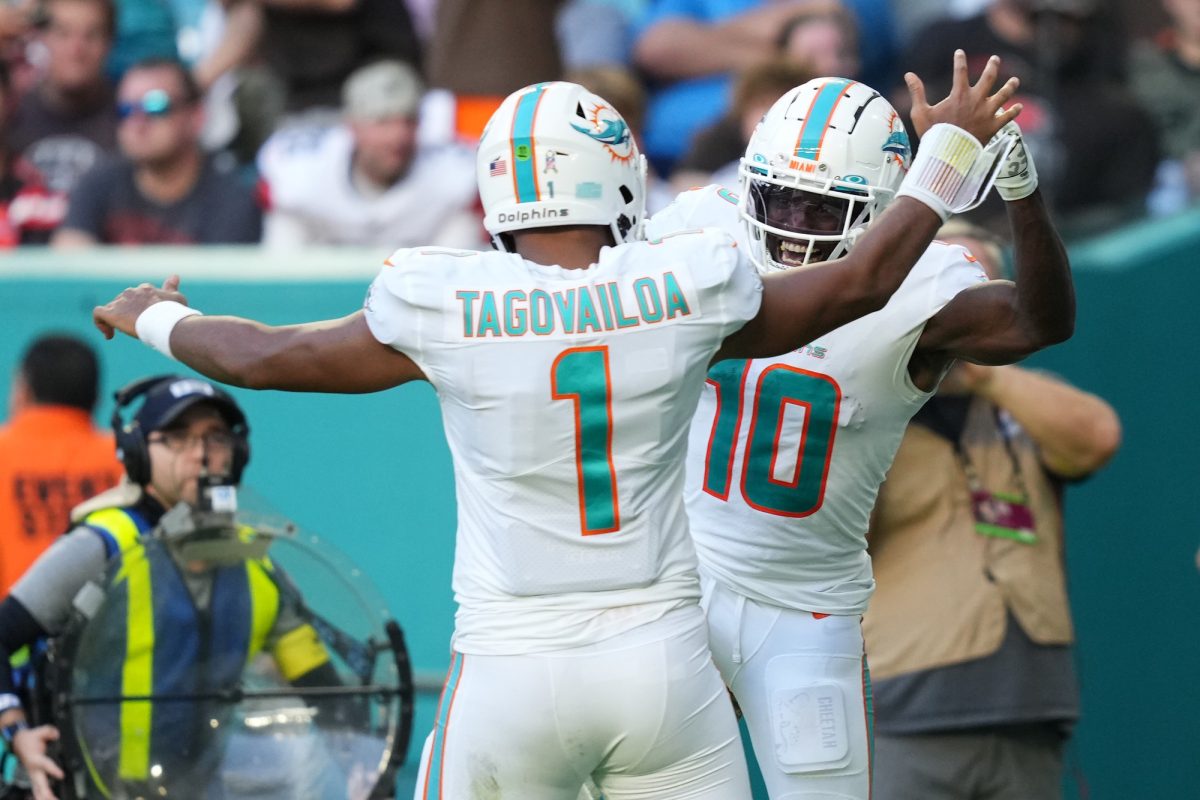



Malik Willis threw his first regular-season touchdown pass for the Miami Dolphins on Sunday, but the milestone offered little relief after a 35-13 loss to the San Francisco 49ers.
Asked about the scoring pass to Ryan Miller, Willis made clear that his happiness for the receiver did not extend to Miami’s performance.
“I felt good for Ryan, I didn’t feel good for the Miami Dolphins,” Willis said.
The answer captured the circumstances surrounding the play. Willis found Miller for a 77-yard touchdown with 2:30 remaining, when San Francisco already held a commanding lead. Miami left Levi’s Stadium 0-2 after the defeat.
RYAN MILLER TAKES IT 77 YARDS pic.twitter.com/nEoNYVHruX
— Dolphin Nation (@Dolphin_Nation) September 20, 2026
There was a positive moment for the two players involved, and Willis acknowledged it. His response also left little room to treat the finish as an endorsement of the offense’s entire afternoon, with the Dolphins still searching for a performance that produces a win.
The late touchdown did not change Miami’s offensive picture
The scoring connection carried some significance beyond the distance of the play. It was Willis’ first touchdown pass as a Dolphin, giving the quarterback a milestone to discuss on an otherwise disappointing day.
According to the official game statistics, Willis completed 14 of 23 passes for 197 yards, one touchdown and no interceptions. Miller’s only reception accounted for 77 yards and the score.
Subtract that completion and Miami’s other 13 catches produced 120 yards. That calculation does not erase a legitimate scoring play, but it shows how much of the passing production arrived in one moment near the end of the game.
Avoiding an interception was a useful part of Willis’ afternoon, although ball security alone cannot establish whether a passing game is operating well. The evaluation also has to account for the opportunities an offense creates and whether it turns them into points.
An offense needs explosive plays, and finding an open receiver for a touchdown is something Miami should want to repeat. Evaluating whether the entire operation is improving requires a broader look at what happens between those opportunities: whether possessions continue, whether protection holds and whether the quarterback has workable answers when the first option is covered.
Willis’ response kept the focus on that larger assignment. He credited Miller without suggesting that a late score had made the afternoon satisfactory, an important distinction when the best offensive highlight comes after the opponent has established control.
Protection remains central to the Malik Willis evaluation
The passing touchdown also did not remove another recurring problem. The 49ers’ official coverage documented Keion White bringing Willis down for San Francisco’s fourth sack of the afternoon.
Palm Beach Post reporter Joe Schad noted during the fourth quarter that Willis had been sacked nine times in his first two Miami games. That leaves the Dolphins with another week of evaluating how their passing plays are developing and where they are breaking down.
Right tackle Austin Jackson acknowledged his own need to improve afterward.
Dolphins right tackle Austin Jackson: “I got to play better.” https://t.co/ktArAmp8zu
— David Furones (@DavidFurones_) September 20, 2026
“I got to play better,” Jackson said.
Jackson’s assessment establishes what he said about his performance; it does not assign him responsibility for every sack. That distinction matters when evaluating Willis, because a sack total records the outcome of a play without identifying every decision that contributed to it.
A missed block, a route that develops late or a quarterback passing up an available throw can all create trouble. Determining which occurred requires reviewing the individual play.
Miami needs that level of diagnosis if it is going to reduce the negative plays without taking away the movement that gives Willis a chance to escape pressure.
Bobby Slowik had already identified the balance Miami needs
Offensive coordinator Bobby Slowik addressed that issue before the trip to San Francisco. In his Sept. 17 media availability, he described multiple contributors to the sacks Miami allowed against Las Vegas, including coaching, blocking, routes and the timing of throws.
Slowik also explained that the Dolphins wanted Willis to retain his ability to extend plays while improving the execution of opportunities designed to get the ball out quickly.
“But I don’t want to take away what Malik’s good at,” Slowik said.
Those were pregame comments about the opener, not Slowik’s assessment of the 49ers loss. They nevertheless identify the balance Miami was already trying to strike heading into Sunday.
The practical challenge is deciding when an extended play still has a reasonable chance to succeed. Mobility can rescue a possession, but an offense cannot depend on the quarterback escaping every time its timing breaks down.
Getting a routine completion on schedule can be as useful as creating an opportunity outside the structure of the play.
The next review should help separate decisions Willis can improve from assignments his teammates need to execute more reliably. A productive response would give each player a specific correction rather than leave the group with only a general demand to play harder.
The Dolphins lost control before Willis found Miller
Miami was still within one possession at halftime, trailing 14-6. The official quarter-by-quarter scoring shows how sharply the game changed: San Francisco scored 21 points in the third quarter while the Dolphins added none.
That put Willis and the offense in a very different position by the final period. Miami needed repeated scoring possessions while also needing the defense to stop San Francisco, leaving little room for another stalled series.
The defense had entered the game without Chop Robinson because of a concussion. Even with that personnel context, the result was a team-wide problem: San Francisco scored touchdowns on its first five possessions.
The offense’s shortcomings therefore belong in the larger account of the loss. Willis could not answer for every phase of the game, but his late touchdown could not offset what had happened across those phases, either.
For Miami’s coaches, that makes the sequence of the game important. A successful play late in a lopsided contest still deserves review for what worked, while the earlier failures need to remain central to deciding what must change before the next opponent.
Willis’ message carries into Miami’s home opener
Willis had already emphasized team results over individual production in his Sept. 16 media session. Asked then about his rushing production, he explained that winning mattered more to him than a statistical competition.
His response Sunday followed that same position. The touchdown gave Miller a moment worth recognizing, but the outcome remained the measure Willis chose when discussing the Dolphins.
That stance also provides a regular-season follow-up to the expectations Willis laid out for Miami’s offense during training camp. The circumstances are different now, with actual losses replacing the practice-field conversations about how the group wants to perform.
Accountability becomes useful when it leads to an identifiable adjustment. For the quarterback, that can mean recognizing an available completion sooner; for the players around him, it can mean supplying the protection and route timing that allow the throw to happen.
The offense needs those pieces to work together often enough that a touchdown is part of a competitive performance.
Miami’s next opportunity comes in its home opener against Kansas City on Sept. 27. Willis has his first touchdown pass with the Dolphins, but his postgame answer made clear that he is still waiting for a much more satisfying result.