

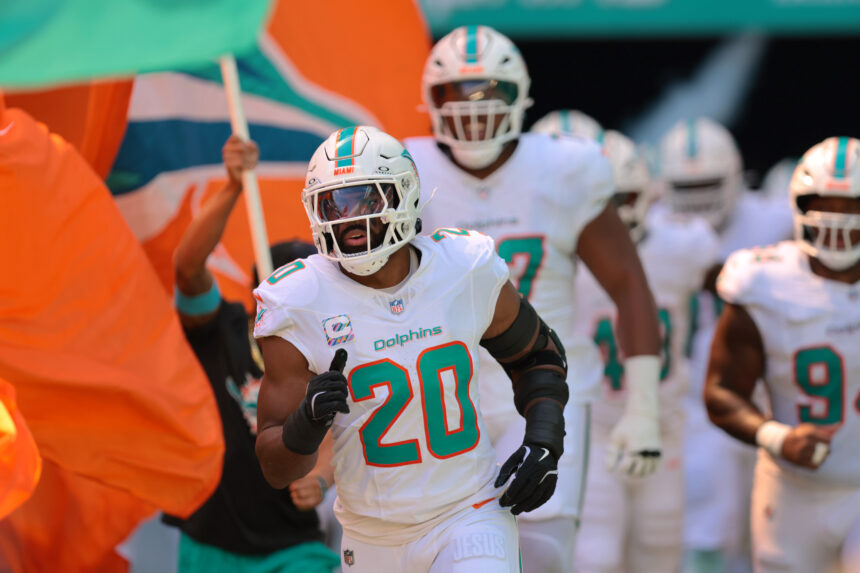
Jordyn Brooks sees a danger in repeated losses that goes beyond the standings: Players can become so concerned with avoiding another mistake that they hesitate to make a play.
Speaking Monday as the Miami Dolphins returned from their bye, the linebacker was asked whether the team had been playing too cautiously. Brooks declined to make that judgment about individual teammates, but explained how defeats can influence the way players approach the next game.
“I mean, you never know,” Brooks said. “I can’t say that somebody’s playing tight, I can’t say that he’s not. You do want to see guys play free. Sometimes what stops you from playing free is losing, honestly. One loss carries into another so you kind of want to play perfect, you don’t want to take a chance. So that’s a real thing for everybody in the league, in any sport. That’s why I kind of like this bye week. It just gives you a chance to reset, kind of just throw everything out the window that’s happened and go out there and play loose, play free, play our best ball.”
In the team’s transcript of his remarks, Brooks described the break as an opportunity to interrupt that cycle. He wanted Miami to return without allowing its previous results to dictate how freely it played.
The Dolphins are 0-5 entering Sunday’s trip to face the New York Jets. Another veteran, Zach Sieler, also emphasized his commitment to the team Monday when he addressed speculation about his future in Miami.
Patrick Paul and Jeff Hafley offer their perspective
Brooks’ answer came amid questions to multiple Dolphins about whether fear of mistakes had affected their performance. Left tackle Patrick Paul rejected that assessment when asked about it during his own media availability.
“I don’t think we did, no,” Paul said. “I think we have a confident group. So I’m in total agreeance with Coach Hafley. But I don’t think we did. I think it’s just a lot of these games are really close and each week we got better. So I think just now coming off this bye week, it’s just a total reset and let’s do it. Finish in the fourth quarter, be the team on top at the end of the game.”
Paul instead identified penalties and inconsistent execution as areas the offense needed to address. He stressed the importance of avoiding situations that make moving the ball more difficult and finishing games more effectively.
That distinction matters when interpreting Brooks’ remarks. Recognizing that losing can encourage caution is not the same as declaring that Miami’s locker room lacks confidence, particularly when Brooks expressly avoided diagnosing his teammates.
Head coach Jeff Hafley was similarly direct when asked about the issue Monday.
“No, not at all,” Hafley said. “I don’t think we’re coaching tight at all, and the film says we’re not playing tight. Our guys are playing hard. No, absolutely not.”
What the Dolphins examined during their bye
Hafley offered a concrete example of the coaching review: Miami revisited defensive concepts it had practiced in training camp but had not included in its early game plans.
The staff considered which ideas to reintroduce and which elements to remove, rather than simply expanding the number of calls players would need to handle.
He also met with offensive coordinator Bobby Slowik and special teams coordinator Chris Tabor to examine adjustments in their units. Hafley described an ongoing process of smaller changes, with the extra time allowing coaches to reconsider their choices.
For Brooks, the defensive priorities included converting opportunities to take possession and correcting issues against both the run and pass. He also benefited physically from the break after briefly leaving the Cincinnati game before returning.
Miami now faces 12 consecutive games following its Week 6 bye. The Jets matchup begins that stretch, with Brooks seeking a defense that capitalizes on its opportunities and Paul looking for an offense that stops making its own possessions harder.